Side-Emitting and Zigzag LED Strips for Even Lightbox Illumination
Side-view and zigzag LED strips for sign lightboxes: 0.6–1.5 W per module, 12 V or 24 V, uniform brightness across 1–3 m boxes, IP65, 5,000-hour test.
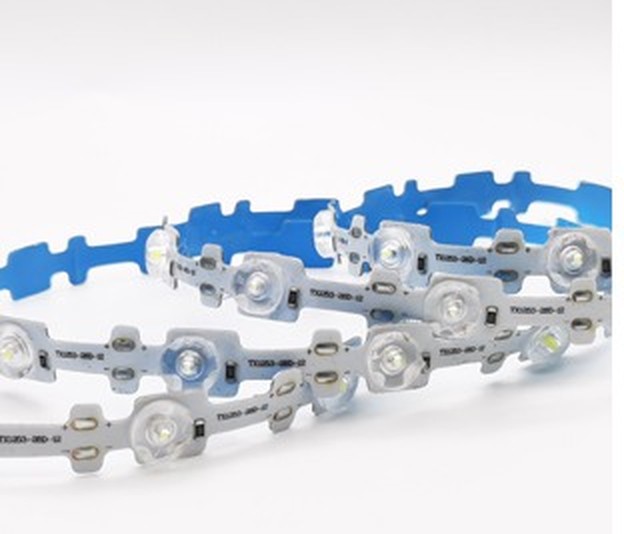
A lightbox LED strip is a side-emitting or zigzag-arranged strip that throws light sideways into the acrylic face of a sign, producing even brightness without the hot spots of a direct-view strip. HFY LED supplies side-view 3014 and 335 strips and zigzag backlight strips at 0.6–1.5 W per module on 12 V or 24 V, sized to box depths from 60 mm to 300 mm, with IP65 sealing for outdoor signs.
Scope: what this product page covers
This page covers strips and modules for internally illuminated signage up to 3 m in the longest dimension. Boxes above 3 m usually need a tensioned fabric system or edge-lit acrylic with a different optical design, and we will say so rather than ship more modules. Neon flex for outline lighting is a separate product page.
Specifications
| Strip types | Side-view 3014 / 335, zigzag backlight modules |
|---|---|
| Power per module | 0.6 W, 0.9 W, 1.2 W, 1.5 W |
| Input voltage | 12 V DC or 24 V DC |
| Box depth range | 60 mm – 300 mm |
| Brightness uniformity | ≥ 85% edge-to-centre on a 1.2 m box |
| Sealing | IP65 for outdoor signs, IP20 for indoor |
| Module spacing | Set per box depth, typically 80–150 mm |
| Lead time | 12–18 working days including layout review |
Materials
- Side-view 3014 and 335 LED packages on 8 mm FPC
- Zigzag FPC with 3-LED cut units for corner routing
- 3M VHB and screw-fix module housings
- IP65 nano coating or silicone sleeve
- 12 V / 24 V waterproof drivers, 60–300 W
Manufacturing process
- Box geometry review Module pitch is calculated from box depth and acrylic diffuser grade rather than from a standard table. A 100 mm box with 3 mm opal acrylic needs modules at 110 mm pitch; the same box with 5 mm acrylic tolerates 150 mm pitch, which reduces module count by 25% and the BOM cost with it.
- Zigzag routing Zigzag FPC allows the strip to run in a serpentine pattern with 3-LED cut units, so a single feed covers the full panel. This removes the multiple feeds and connectors of a row-by-row layout, which is where most lightbox failures originate.
- Uniformity test Every layout is validated in a physical test box before production: brightness is measured at the centre, edge and corner, and the target is ≥ 85% edge-to-centre. A layout that fails is corrected by changing pitch, not by adding modules.
- Sealing for outdoor use Outdoor modules are nano-coated and the interconnect is silicone-sealed, then the assembly runs a 30-minute water spray test. Sign cabinets leak at the top seam, so the strip is mounted 20 mm above the cabinet floor to stay out of standing water.
- Packing by panel Modules are packed per panel with a layout drawing and numbered leads, so the sign fabricator installs in the tested pattern. Mixed packing is the main cause of a box that measures unevenly after installation.
Lightbox & Side-Emitting Strip in production
Typical applications
- Illuminated shop fascia and pylon signs
- Menu boards and wayfinding lightboxes
- Airport and transit signage
- Retail display and poster frames
- Museum graphic panels with strict uniformity
- Pharmacy and convenience store cross-lit signage
Quality and documentation
- Layout validated in a physical test box before production
- Uniformity measured at centre, edge and corner of each panel
- 30-minute water spray test on IP65 outdoor builds
- 5,000-hour continuous test on new module designs
- CE, RoHS and REACH documentation
What we do not do
We do not supply lightbox modules for boxes deeper than 300 mm, because at that depth direct-view strip in a reflective box is cheaper and performs better than side-emitting modules. We also do not guarantee uniformity on acrylic thinner than 2 mm or on clear acrylic without a diffuser: the optical design, not the LED, sets what the face looks like.
Technical questions
How many modules do I need for a 2 m lightbox?
For a 2,000 × 1,000 mm box at 100 mm depth with 3 mm opal acrylic, plan on 18–20 modules at 0.9 W spaced on a 150 mm grid. That is roughly 16–18 W total, or 130–150 lm per module at 12 V — enough for a face luminance of 500–700 cd/m², which is the range most fascia signs target.
Why is my lightbox brighter in the middle than at the edges?
Module pitch is too wide for the box depth, or the strip runs only down the centre. Side-emitting modules spread light along their length, so they must run parallel to the edge they are lighting, typically 60–80 mm in from the frame. Adding modules in the centre makes the problem worse.
Can one power supply feed a whole sign?
Up to 80% of the driver rating, not 100%. A 300 W driver should carry 240 W of modules, because a sealed sign cabinet reaches 50–60 °C internally in summer and driver output derates about 10% above 40 °C. Outdoor signs also need the driver in a separate IP65 enclosure.
Adjacent products and capabilities
COB LED Strip
A COB LED strip is a flexible linear light source in which bare LED dies are bonded directly onto the FPC and sealed under one continuous phosphor layer, so the light is dot-free instead of showing individual emitters. HFY LED builds COB strips at 320, 480 and 504 chips per metre on 24 V, delivering 8–15 W/m at CRI 90–95 with SDCM ≤ 3 colour consistency, in reels from 5 m to 50 m and sealing from IP20 to IP68..
View productSMD LED Strip
An SMD LED strip carries packaged surface-mount LEDs on a flexible PCB at a fixed pitch, which makes it the lowest cost per lumen option for volume lighting. HFY LED produces 2835, 5050 and 5630 strips from 60 to 240 LEDs per metre on 12 V or 24 V, at 100–190 lm/W and CRI 80–90, with reels from 5 m and typical production lead times of 15–20 working days..
View productSilicone Neon Flex
Silicone neon flex is a flexible linear light in a solid silicone profile that diffuses the LED source into an even, continuous line while sealing the electronics to IP67. HFY LED extrudes neon flex in 6×12 mm, 8×16 mm and 10×20 mm profiles on 12 V or 24 V, at 5–12 W/m, in top-bend and side-bend versions, from 2700 K to 6500 K plus RGB and RGBW..
View productQuality & Testing
100% reel electrical test, 24-hour burn-in and SDCM ≤ 3 binning on every order.
Testing capabilitySend a specification, get a quotation in 24 hours
Tell us the product type, run length, wattage, CCT, CRI and IP rating. You will receive a fixed price, a lead time, and the feed and driver arrangement in writing — no obligation, and no sales call unless you ask for one.