
Retail Shelving Rollout: CRI 95 Strip Across 180 Stores in 11 Months
How a fashion retailer rolled out CRI 95 COB shelf strip to 180 stores in 11 months with one bin record, 4,800 reels and zero colour-match complaints.
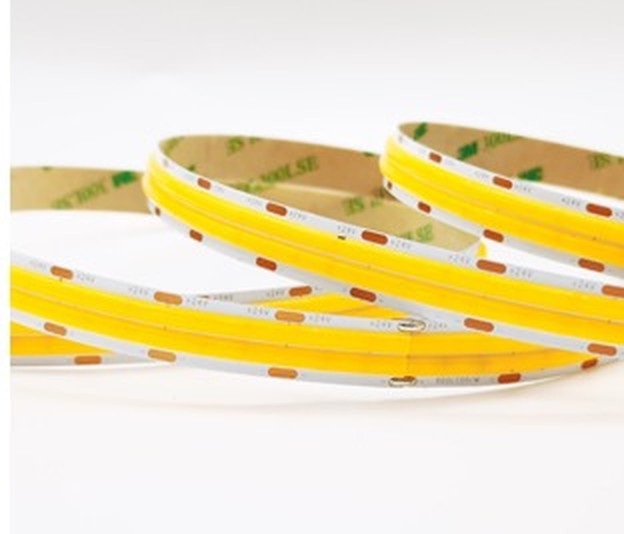
A fashion retailer was replacing shelf lighting across 180 stores over 11 months, and the risk was colour drift between stores as production lots changed. HFY LED supplied 4,800 reels of CRI 95 COB strip from a reserved die bin, with a bin record per store and a 2% spare allocation held in a central warehouse, and no store reported a colour-match complaint in the first year.
The starting condition
Each store has 26–32 m of shelf strip across four floors, and stores were being refitted in clusters of 12–15 per month. The previous supplier delivered on a 12-week lead time with no bin commitment, so stores refitted six months apart had visibly different whites in the same product category. The retailer had also specified CRI 90, which left red garments looking flat under the shelf light.
Constraints
| Total volume | 4,800 reels of 5 m across 180 stores |
|---|---|
| Colour rendering | CRI 95, R9 ≥ 60 |
| Colour consistency | SDCM ≤ 3 between stores |
| Reel length | 5 m, pre-terminated with JST SM |
| Programme | 11 months, 12–15 stores per month |
| Spares | 2% of installed length held centrally |
Measured results
- Colour-match complaints
- Fitting labour per store
- Replacement lead time
- Colour rendering
What we changed, and why
- Reserve the die bin before the first store The full 24,000 m was reserved against one CRI 95 die bin before the rollout started. Colour drift between stores was the single largest risk in the programme, and holding the bin was the only control that worked at this scale — re-binning mid-programme would have produced a visible difference between store clusters.
- Move the specification from CRI 90 to CRI 95 We supplied CRI 90 and CRI 95 samples for a side-by-side test on the same rail of garments. The retailer changed the specification on the evidence: reds and navy read correctly under CRI 95 with R9 at 62, and the 12% cost increase was accepted against the cost of a second refit.
- Pre-terminated reels per store Each store received its reels cut to the installed length with JST SM connectors fitted and pull-tested, labelled by floor and bay. Store fitters had been cutting and soldering on site, which produced inconsistent joints and about 40 minutes of extra labour per store.
- Bin record and spare allocation per cluster Every store has a bin record filed against its cluster, and 2% spares from the same bin are held centrally. A failed section is now replaced from stock in two days rather than triggering a production order for a single reel.
“The rollout was boring in the best way. Every store looked the same, which is all we wanted and what the last supplier could not deliver.”
Store development manager, Fashion retail chain, Germany — Fashion retail chain, 180 stores
Where this approach stops working
A reserved bin works above roughly 5,000 m per programme. For a single-store refit the correct answer is stock strip from a current bin plus a labelled spare reel; reserving production for 32 m would multiply the unit price for no visible benefit.
Parts and process

Products used in this programme
COB LED Strip
A COB LED strip is a flexible linear light source in which bare LED dies are bonded directly onto the FPC and sealed under one continuous phosphor layer, so the light is dot-free instead of showing individual emitters. HFY LED builds COB strips at 320, 480 and 504 chips per metre on 24 V, delivering 8–15 W/m at CRI 90–95 with SDCM ≤ 3 colour consistency, in reels from 5 m to 50 m and sealing from IP20 to IP68..
View productSMD LED Strip
An SMD LED strip carries packaged surface-mount LEDs on a flexible PCB at a fixed pitch, which makes it the lowest cost per lumen option for volume lighting. HFY LED produces 2835, 5050 and 5630 strips from 60 to 240 LEDs per metre on 12 V or 24 V, at 100–190 lm/W and CRI 80–90, with reels from 5 m and typical production lead times of 15–20 working days..
View product1,100 m of Facade Neon Flex Without a Single Visible Colour Step
Read case studyLightbox Modules: 22% Fewer Modules at Higher Uniformity
Read case studySend a specification, get a quotation in 24 hours
Tell us the product type, run length, wattage, CCT, CRI and IP rating. You will receive a fixed price, a lead time, and the feed and driver arrangement in writing — no obligation, and no sales call unless you ask for one.