
LED Strip for Architectural Cove, Profile and Feature Lighting
COB and SMD strip for cove, profile and feature lighting: SDCM ≤3, CRI 90–95, 24 V long runs, constant-current options and project-level bin records.
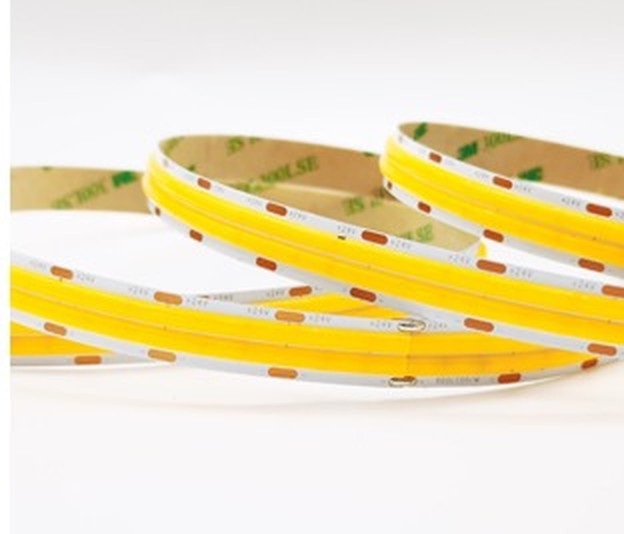
Architectural lighting specifications turn on colour consistency, dimming behaviour and serviceability rather than on price per metre. HFY LED supplies COB and high-CRI SMD strips at SDCM ≤ 3 with CRI 90–95, in 24 V runs up to 10 m from one feed and 50 m reels, and holds a bin record per project so replacement strip matches the installed installation years later.
Scope of supply in this sector
We supply strip and drivers to lighting designers, M&E contractors and fixture integrators. We do not design the lighting scheme, produce Revit families or take responsibility for lux levels on site — those sit with the lighting designer, and we will provide photometric files for their calculation.
Requirements
| Colour consistency | SDCM ≤ 3 across the whole project |
|---|---|
| Colour rendering | CRI 90 minimum, CRI 95 for hospitality |
| Dimming | 0–100% with no flicker below 5%, PWM ≥ 1.5 kHz |
| Voltage | 24 V for runs above 5 m; 48 V for long perimeter runs |
| Rated life | L70 ≥ 50,000 h at 45 °C ambient |
| Documentation | LM-79 report, IES file, bin record per lot |
Materials and profiles for this sector
- COB strip at 320 and 480 chips/m for reflected coves
- SMD 2835 CRI 95 strip for indirect lighting in profiles
- Aluminium profiles with opal or micro-prismatic diffusers
- 24 V and 48 V constant-voltage drivers, DALI and 0–10 V dimmable
- Constant-current modules for long runs with multiple feeds
Applicable standards
- IEC 62031 for LED modules
- IEC 62471 photobiological safety
- LM-79 and LM-80 photometric reporting
- EN 60598 for the completed luminaire
- CE and RoHS declarations for all strip
Typical parts
- Cove and cornice lighting in hotels and lobbies
- Recessed ceiling perimeter lighting
- Joinery and shelving integration
- Wall-wash and grazer profiles on stone and timber
- Stair nosing and handrail lighting
- Backlit translucent panels and onyx features
Quality risks specific to this sector
These are the failure modes we see most often in this industry. They are listed because knowing them before design review is cheaper than discovering them at first article.
- Mixing production lots in one continuous cove produces a visible tint step even at SDCM 3 — the fix is a single lot per elevation, ordered with 10% spare
- Dimming below 5% reveals driver PWM artefacts: a 200 Hz driver flickers visibly on camera even when it looks steady to the eye
- Sealing an aluminium profile with no ventilation raises the strip temperature 15–20 °C, which cuts rated life by roughly 40%
Compliance and capability questions
How much spare strip should I order for a project?
Ten percent, and from the same production lot. Spare strip matters less for replacement than for the last few metres of an elevation where cutting losses accumulate; ordering spares from a later lot is the most common cause of a visible colour step six months after handover.
Can you supply IES files for lighting design?
Yes, for each LED type and profile combination we produce, measured on the integrating sphere. For a custom profile the IES file describes the bare strip, not the profile, so the designer should apply the diffuser loss of 8–15% in their calculation.
What CRI do I need for a hotel lobby?
CRI 90 with R9 above 50 is the practical minimum for interior hospitality work; below that, skin tones and timber read grey. CRI 95 costs 10–15% more per metre and is justified where the lighting is the design feature rather than the backdrop.
Industries we also supply
Signage & Lightboxes
Signage lighting is judged on uniformity and service life, because a sign that goes patchy is a visible brand problem. HFY LED supplies side-emitting and zigzag strips plus backlight modules for boxes from 60 mm to 300 mm deep, validates each layout in a physical test box to ≥ 85% edge-to-centre uniformity, and seals outdoor builds to IP65 with a 30-minute spray test..
View sectorRetail & Display
Retail lighting has to render merchandise accurately and disappear into the fixture. HFY LED supplies CRI 95 COB strip at SDCM ≤ 2 for shelving and display cases, in 8 mm and 10 mm widths that fit inside 15 mm aluminium profiles, with 0–100% dimming through DALI, 0–10 V or phase-cut drivers..
View sectorHospitality & Leisure
Hospitality projects need warm, dimmable light that survives cleaning chemicals and stays repairable for a decade. HFY LED supplies CRI 95 COB strip in 2700 K and 2400 K, warm-dim drivers that shift to 1800 K at low output, and IP67 neon flex for spa and pool areas, with the bin record held per project so refurbishment reels match the original..
View sectorSend a specification, get a quotation in 24 hours
Tell us the product type, run length, wattage, CCT, CRI and IP rating. You will receive a fixed price, a lead time, and the feed and driver arrangement in writing — no obligation, and no sales call unless you ask for one.